✅ Put your name here

A reflection on what you’ve learned so far and an introduction to Generative Artificial Intelligence!
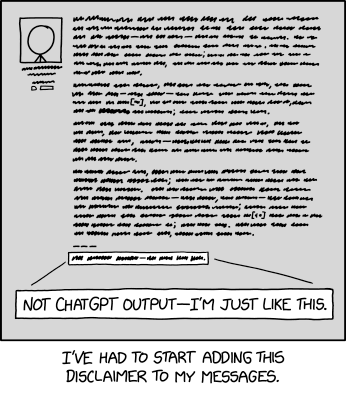
Credits: xkcd.com
Learning goals for today’s assignment
Identify the content we’ve covered thus far in the course that you feel confident about
Identify the content that you feel like you could use more practice with or feel less confident about
Come up with a strategy for patching the gaps in your understanding or new computational skillset
Assignment instructions
Watch the videos below, do the readings linked to below the videos, and complete the assigned programming problems. Please get started early, and come to office hours if you have any questions! Make use of Slack as well!
This assignment is due by 11:59 p.m. the day before class, and should be uploaded into appropriate the “Pre-class assignments” submission folder. Submission instructions can be found at the end of the notebook.
Overview of the concepts we’ve covered so far
Thus far in the course we’ve gone through a number of fundamental Python concepts and practiced a variety of programming skills. For many of you, just a few weeks ago, you had no prior coding experience and now you’re writing algorithms that tackle a variety of problems.
The key Python (and general programming) concepts we’ve covered so far to build algorithms include the following:
Defining variables in Pythong (e.g. intergers, floats, strings, lists)
Doing simple math using arithmetic operators (e.g.
+,-,*,/) and concatenation of strings (also using+)Storing information in lists and manipulating them by change values or appending values
Writing
forloops andwhileloops to loop in the following ways:Looping by integer or index (i.e.
for i in range(len(mylist)):)Looping by value over a list (i.e.
for val in list_of_values:)Looping by condition (i.e.
while n < cut_off:)
Controlling code flow using conditional statements (
ifstatements as well aselifandelse)Defining functions to write code that is modular, resuable, and useful.
Understanding error messages and trouble-shooting code when bugs arises (i.e. “debugging” your code). You’ve been doing this implicitly throughout the course!
We also spent some time talking about data ethics and specifically looked at how things issues data bias and algorithmic bias exist in the modern world. We reflected on how to push against these biases and considered how we can hold ourselves to high ethical standards and uphold academic integrity as we work through the materials in this course.
Now is the time to pause, look back, and consider what you feel like you know and what you could still use more time and practice with.
A moment of self-reflection
As we find ourselves learning new things and pushing the boundaries of our current, we can often feel like we are constantly in a state of not knowing. This can be a bit overwhelming if we stay in that state constantly, so this pre-class assignment is an opportunity to take a breath, and review all of things you have already learned in just a few class periods.
Review list of concepts and ideas above that we’ve covered so far in class and then respond to the following prompts:
✅ Question 1
What concepts and Python skills do you feel like you have a strong understanding of and could use to solve a problem or build an algorithm? List all of the concepts for which this is true.
✎ Put your response here.
✅ Question 2
What concepts and Python skills do you feel like you have a weaker understanding of and might struggle to use to solve a problem or build an algorithm? List all of the concepts for which this is true.
✎ Put your response here.
✅ Question 3
Are there any concepts that you feel like you don’t understand at all currently? If so, make note of them here. List all of the concepts for which this is true.
✎ Put your response here.
✅ Question 4
Take a look back through the assignments we’ve completed so far in the course. Are there any specific assignments that you would like to revisit or having lingering questions about?
List all of the assignments for which this is true and make note of the ones you would most like to discuss with someone. You’ll have the opportunity in class to ask some of these questions.
✎ Put your response here.
✅ Question 5
In reflecting on the videos you watched, the articles you read, and the discussions you had in class regarding data bias and algorithmic bias, what were some of the big take-aways you ended up with? What surprised you the most, if anything? What things might you do in the future to increase your awareness of these issues or prevent yourself for perpetuating some of this same bias?
✎ Put your response here.
Coming up with a plan
Now that you’ve reflected on the course up to this point and where you feel confident and where you feel less confident, what is your plan for trying to address the weaker points or patch some gaps in your knowledge or skills? You should come up with a plan that is more specific than “Go to office hours or help room”.
✅ Question 6
Think about the key areas where you feel like your confidence and abilities could be increased and try to come up with some concrete questions to ask, previous assignments you could work through again, or specific practice opportunites you plan to seek out to boost your confidence, knowledge, and skills. Record these ideas below.
Learning to write code and build algorithms takes practice and time, but coming up with a concrete plan can help to make your effort more impactful.
✎ Put your response here.
Contexting Generative AI in PLNT_SCI 2500
In class, you will spend some time working on the concepts you are feeling unsure about, but we will also explore the potential and drawbacks of using Generative Artificial Intelligence (AI) tools like ChatGPT, Dall-E, Claude, Co-Pilot, etc. in PLNT_SCI 2500.
As we navigate the use of generative AI in courses, we must design policies that focus on the use of these tools for the purpose of learning. Our tools should deepen our understanding of the subject, extend our abilities to investigate and create, and provide a reproducible and transparent process.
It is very easy to circumvent those goals with Generative AI.
✅ Task 7
Please choose TWO of the items below to review prior to answering the Discussion Questions. Note: Some are shorter, and some are longer, some are podcasts, and some are written. You may choose any two!
✅ Question 8
Read the prompts below. Record your thoughts about the prompts in the cell below.
What forms of AI use are acceptable to me? Why do I think that?
How would I demonstrate that I understand the material in PLNT_SCI 2500 (i.e. your work is not just the product of AI)?
What forms of documentation should be used to indicate that I used AI tools?
When is it unacceptable to me to use AI in this class? Why do I think that?
What should happen if someone is using AI in this class in a way that I find inappropriate?
✎ Put your response here.
What will we be doing in-class based on what you’ve done here?
In class, we’ll start with group and class discussion and exploration of Generative AI tools. Then we’ll be taking a sort of “choose your own adventure” approach to brushing up on some of the concepts and skills you feel like you would use more practice or time with. There will be a variety of content and concepts available and you’ll be able to spend time reviewing and practicing in the key areas where you feel like you could use the extra practice. The instructors will be available to help answer questions and address any gaps you feel like you might have in your knowledge or skillset right now. You can also use this class time to ask questions about previous assignments that you haven’t had a chance to get answered.
Make sure you think about which of these areas you’d most like to spend some time on before you come to class
You’ll also be able to use the Day 7 in-class assignment as a tool for preparing for the first homework as well!
Follow-up Questions
Copy and paste the following questions into the appropriate box in the assignment survey include below and answer them there. (Note: You’ll have to fill out the section number and the assignment number and go to the “NEXT” section of the survey to paste in these questions.)
Copy and paste your answer to Question 5 under the Generative AI Questions above into your pre-class survey.
Considering your responses to the questions concept review prompts, which concept do you feel like you are most confident in right now?
Which concept do you have the most questions about or could use the most time practicing?
What concerns, if any, do you have about the first homework?
Congratulations, you’re done!
Submit this assignment by uploading it to the course Canvas web page. Go to the “Pre-class assignments” folder, find the appropriate submission folder link, and upload it there.
See you in class!
Material drawn with permission from:
© Copyright 2023. Department of Computational Mathematics, Science and Engineering—Michigan State University
Adapted for:
© Copyright 2026, Division of Plant Science & Technology—University of Missouri
- Bozkurt, A., Xiao, J., Farrow, R., Bai, J. Y. H., Nerantzi, C., Moore, S., Dron, J., Stracke, C. M., Singh, L., Crompton, H., Koutropoulos, A., Terentev, E., Pazurek, A., Nichols, M., Sidorkin, A. M., Costello, E., Watson, S., Mulligan, D., Honeychurch, S., … Asino, T. I. (2024). The Manifesto for Teaching and Learning in a Time of Generative AI: A Critical Collective Stance to Better Navigate the Future. Open Praxis, 16(4), 487–513. 10.55982/openpraxis.16.4.777