✅ Put your name here

Assessing statistical differences with the t-test and the importance of good visualizations
Credits: xkcd.com
Learning goals for today’s pre-class assignment
Be able to articulate what a t-test is and its three main flavors
Use SciPy to compute a t-test and its associated p-value
Interpret correctly the meaning of the p-value
Emphasize the need for good data visualization to guide our statistical conclusions.
Assignment instructions
This assignment is due by 11:59 p.m. the day before class, and should be uploaded into the appropriate “Pre-class assignments” submission folder. If you run into issues with your code, make sure to use Slack to help each other out and receive some assistance from the instructors. Submission instructions can be found at the end of the notebook.
1. Introduction to one- and two-sample t-tests
In many applications, you’ll find yourself taking measurements from different groups and then wondering if these groups are statistically the same or not. You might compare male vs female, control vs treatment, wild type vs mutation, day 1 vs day 20, etc. That is, you have one or two samples you want to compare. You then need a one- or two-sample test.
The most common one- and two-sample tests—very much obsolete— are the Student’s t-tests.
Watch the video below to learn more about (Student’s) t-tests.
Important: Do not worry too much about the math discussed across the video. The t-tests are outdated—but still taught due to inertia. There are much more powerful alternatives readily available in Python which we will discuss later.
However, t-tests are a good entry point to the whole one- and two-sample test discussion we’ll have below. Make note that early on, the video describes three kinds/types of t-tests which correspond to three null hypotheses:
There is no statistical difference between the mean of this one sample and this fixed value.
There is no statistical difference between the means of these two independent samples.
There is no statistical difference between the means of these paired samples.
from IPython.display import YouTubeVideo
YouTubeVideo("a9liXroJyPg",width=640,height=360, end=9*60) ✅ Question 1
In your own words, explain the three main kinds/types of t-tests described in the video.
✎ Put your three answers here.
✅ Question 2
Say you are hired as a data analyst for MU’s UDAIR (University Data, Analytics, and Institutional Research). You have access to all the (anonymized) student enrollment data.
For each of the three t-test kinds, describe a question that you could answer with UDAIR’s data and a t-test.
✎ Put your three answers here.
2. Going through an example: contaminated pollen
Adapted from: Kettenbach et al (2017)
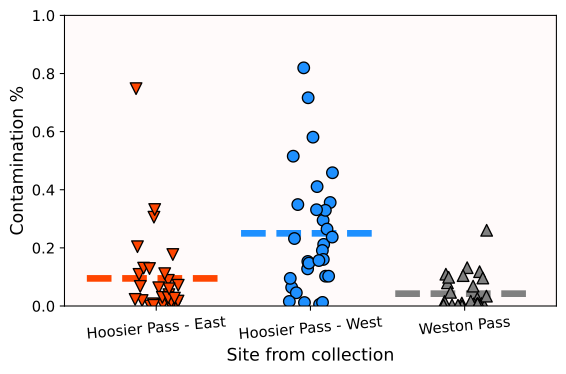
Let’s revisit the data from contaminated pollen we saw in In-Class 15. The data above is adapted from Kettenbach et al (2017), Figure 5. Kettenbach et al. took samples from pollen found on alpine skypilot plants (native) across different locations and altitudes in Colorado. The locations are Hoosier East (HE), Hoosier West (HW), and Weston Pass (WP). The y-axis is the percentage of pollen found that it is actually from willow (invasive).
(This same figure can be opened in this tab if you prefer to switch windows instead of scrolling up and down.)
✅ Question 3
Say you are working in the Alpine Skypilot Lab. You want to know if the pollen is more contaminated in certain Colorado regions compared to others.
Looking just at the data, which locations seem to have similar contamination levels?
Which locations seem to have different levels?
✎ Put your answer here.
✅ Question 4
Visualization is crucial. But so is statistics. It is the combination of both that can reveal the whole story.
Which of the three t-test types is the correct one to use?
✎ Put your answer here.
2.1 Nuances of the p-value
Every t-test comes with an associated p-value from which you make a decision on whether you reject or keep the null hypothesis. In this case, the null hypothesis is:
There is no statistical difference between the mean of these two samples.
The p-value indicates the probability that the differences you observe in the data—if any—are caused by sheer chance. So a large p-value should prevent you from rejecting the null hypothesis. Some important points to consider:
Not rejecting the null hypothesis does not necessarily mean that the null hypothesis is true.
The p-value does not tell you how different two samples are. It just gives you an assessment on how likely the difference between samples is due to randomness.
A p-value is just an indicator of which call might be the correct one, but ultimately you are the one who has to make the call.
The best and only way to make that call is by combining domain knowledge , data visualization, and statistics and make sure the three agree on the same story.
✅ Question 4
The real p-values for the independent samples t-tests are as follows:
| t-test Comparison | p-value |
|---|---|
| HE vs HW | 0.002 |
| HE vs WP | 0.756 |
| HW vs WP | 2 ×10⁻⁶ |
Using both the table and the scatterplot, answer True or False for each statement and explain your choice. Go with your best guess.
Hoosier East and Weston Pass have similar levels of pollen contamination.
Hoosier East and Hoosier West have different levels of contamination.
Hoosier West is a 1000 times more different than Weston Pass.
✎ Put your three answers here.
3. Welch’s t-tests and a why you should almost never do a Student’s t-test
As mentioned in the video above, for Student’s t-tests to be valid, you need your samples have to be:
Normally-ish distributed
Homoscedastic aka have the same variance or standard deviations
That requires you to check for these two prior conditions before doing Student’s t-tests. However, with Welch’s, you only need to check if your data is normal-ish. Welch’s t-tests are an alternative that do not require homoscedasticity.
Historically, Student’s was developed 50 years before Welch’s. And the math and computations behind Welch’s are much longer than those behind Student’s. Back in the pre-computer days, it was too much work to compute Welch’s, so people used almost exclusively Student’s. And it stuck.
Ironically, it is a self-preserving cycle: people are only taught Student’s t-tests. They publish actual research with Student’s. And thus they keep teaching Student’s to new generations, which in turn will use it and teach it. Break the cycle!
In general you should use Welch’s t-test instead of Student’s. Welch’s might be a bit off compared to Student’s if your sample size is small (n = 10 or less). But with small sample sizes, no test will be perfect.
4. Computing two independent-sample Welch’s t-tests with SciPy
Just like with linear regressions, SciPy’s stats submodule can compute Welch’s t-tests for us.
stats.ttest_1sampdoes a 1-sample t-test.The first type: comparing whether one sample mean is the same as a fixed value.
The third type: comparing whether the mean difference between two samples is zero, which is equivalent to compare whether there was a significant change in the same sample.
stats.ttest_indwith theequal_var = Falseparameter does a 2-independent samples t-test.The second type: comparing whether the means from two samples are statistically the same
4.1 The usual setup
We will use the same data from Kettenbach et al (2017) discussed in Section 2.
Before doing any stats, as always, we import packages, load the data 2016+population+survey.csv, and drop NaNs.
import pandas as pd
import matplotlib.pyplot as plt
import numpy as np
from scipy import stats
data = pd.read_csv('2016+population+survey.csv').dropna(axis=0, how='any')
print(data.shape)
data.head()(120, 7)
Then we get three Series (1D DataFrame). Each Series contains the pollen contamination percentages found at each of the three sites we are studying. We name these three Series based on the site acronyms we used in Section 2.
✅ Task 5
Comment what each of the lines below is doing
# Comment each line here
sites = ['Hoosier Pass - East', 'Hoosier Pass - West', 'Weston Pass']
contamination = []
for site in sites:
    pollen_site = data.loc[data['site'] == site, 'frequency of Salix pollen']
    contamination.append(pollen_site)
HE, HW, WP = contamination
✅ Task 6: Your turn
Use
stats.ttest_indto compute the t-test and its associated p-value when comparing the pollen contamination differences across the three sites. (That means you need to compute three tests)?Do your values match the with those in the table in Section 2?
Remember to use the equal_var = False parameter to compute a Welch’s t-test.
# Your code✅ Question 7
Take a look at Figure 5 from Kettenbach et al (2017). It is the same data from Section 2 (with an additional site), except Kettenbach uses boxplots. Ignore the box corresponding to Pennsylvania Mountain.
What do you think the
aandbs mean on top of the boxplots?
Your best guess is fine. We’ll discuss it in class tomorrow.
✎ Put your answer here.
5. What if the data is not normally distributed? Do non-parametric tests!
Welch’s t-test requires your samples to be normally distributed. Actually, normal-ish—we’ll discuss more on the -ish next class. But sometimes, your data is clearly not even close to being normal. In that case, we can do non-parametric tests!
To do one-sample or paired-sample tests, go for a Wilcoxon signed-rank test.
You can compute it with the
stats.wilcoxonfunction.
To do two independent sample tests, go for a (Wilcoxon)-Mann-Whitney U-test.
You can compute it with the
stats.mannwhitneyufunction.
Remember that a normal curve is a parametric distribution: we only need to know two parameters to draw it: mean and standard deviation. Tests that do not assume that data follows a specific parametric distribution—usually normal—are referred to a non-parametric tests.
The key idea behind all non-parametric tests is that they consider the rank of the datapoints instead of their actual numerical values. Think of how Pearson’s correlation compares to Spearman’s.
Watch the first 2:30 minutes of the following video on U-tests. (The rest of the video goes into how to use other software to make the computations, which we don’t really need to know.)
from IPython.display import YouTubeVideo
YouTubeVideo("LcxB56PzylA",width=640,height=360, end=2*60+30) 5.1 So why don’t we ditch Welch’s and do U-tests all the time?
You might be tempted to ditch Welch’s t-tests in favor of Mann-Whitney tests. With the latter you don’t need to check for normality. It’s a win!
However, there is no free lunch. While non-parametric tests have less requirements, they have less power. Non-parametric tests can be inaccurate if you have small sample sizes, or if the difference in sample means is small.
Watch the first 2:20 minutes of the following video to drive that point home.
from IPython.display import YouTubeVideo
YouTubeVideo("ftnOBcXtBEQ",width=640,height=360, end=2*60+21) ✅ Question 8
In your own words:
What is the main difference(s) between a Welch’s t-test and a Mann-Whitney U-test?
Why is Pearson correlation considered a parametric test while Spearman correlation is called a non-parametric one?
✎ Put your answer here.
Congratulations, you’re done!
Submit this assignment by uploading it to the course Canvas web page. Go to the “Pre-class assignments” folder, find the appropriate submission folder link, and upload it there.
See you in class!
© Copyright 2026, Division of Plant Science & Technology—University of Missouri
- Kettenbach, J. A., Miller‐Struttmann, N., Moffett, Z., & Galen, C. (2017). How shrub encroachment under climate change could threaten pollination services for alpine wildflowers: A case study using the alpine skypilot,Polemonium viscosum. Ecology and Evolution, 7(17), 6963–6971. 10.1002/ece3.3272
- Delacre, M., Lakens, D., & Leys, C. (2017). Why Psychologists Should by Default Use Welch’s t-test Instead of Student’s t-test. International Review of Social Psychology, 30(1), 92–101. 10.5334/irsp.82