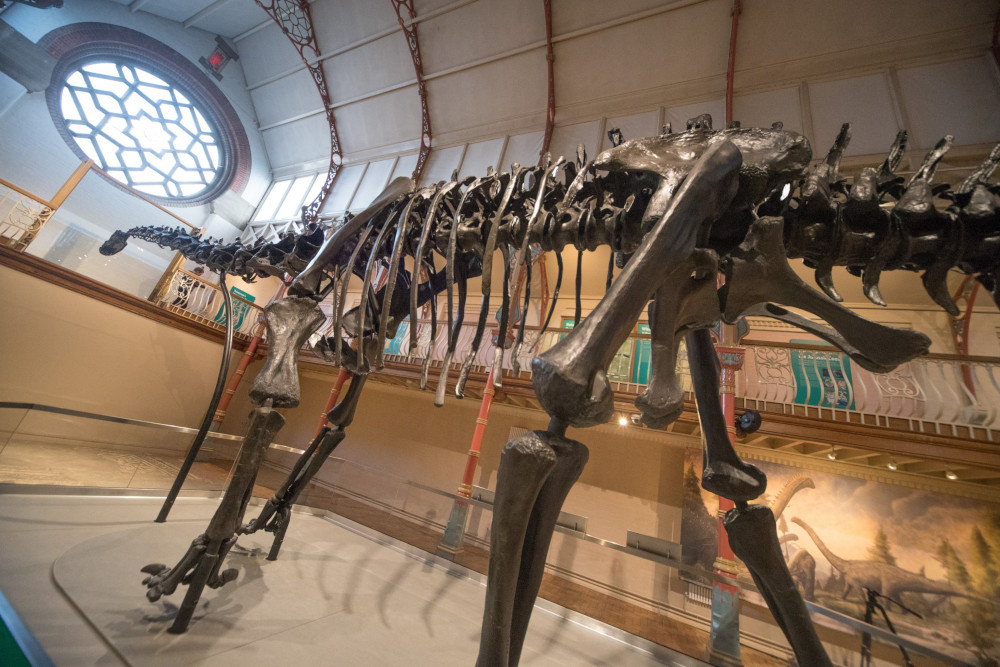
How heavy was a diplodocus?
Credits: Newsweek
Learning goals of today’s assignment
Compute and plot confidence bands for allometry models
Use the linear model to estimate the weight of the diplodocus and estimate its confidence interval
Assignment instructions
Work with your group to complete this assignment. Instructions for submitting this assignment are at the end of the Notebook. The assignment is due at the end of class.
Importing the modules that we will need
Before we start anything, it is good practice to have all our imports as the first Python cell
import numpy as np
import matplotlib.pyplot as plt
import pandas as pd
from scipy import stats
from sklearn import metrics
1. Allometry, revisited
In this Notebook we will recall the femur-humerus-weight allometry dataset from Days 09 and 10. In those assignments, we set to model body weight based solely on humerus and femur’s circumferences based on an allometric relationship:

for some constant values .
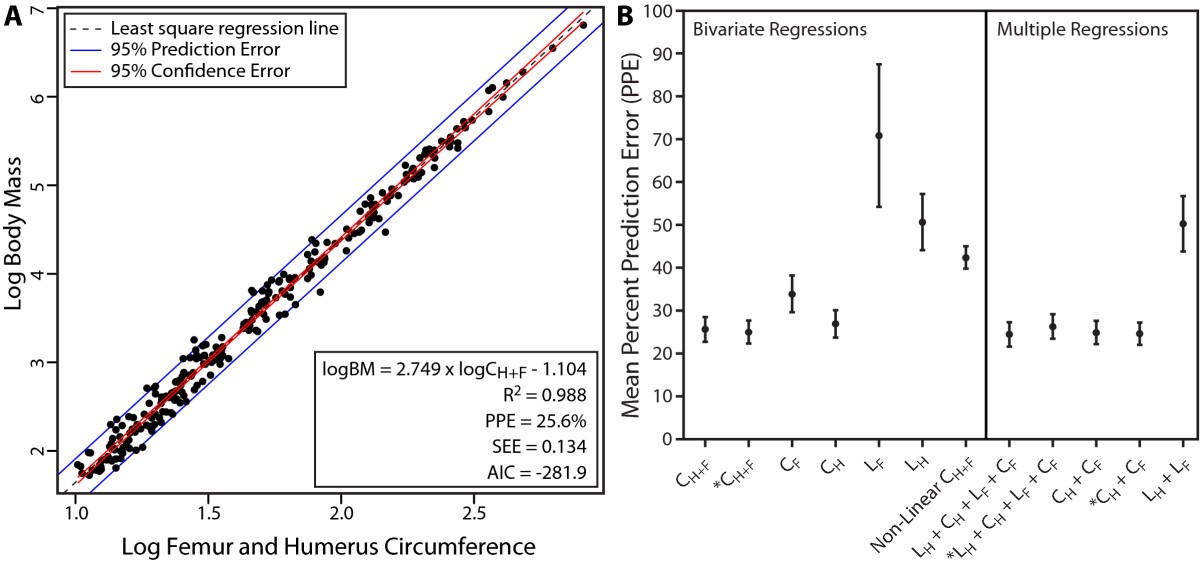
Credits: Campione and Evans (2012)
We will use data from Campione and Evans (2012) to compute a linear model to then predict the weight of various dinosaurs using their fossil data.
1.1 Data loading and visualization
✅ Task 1
Load the
'12915_2012_575_MOESM1_ESM.XLS'file (attached in Canvas). Mind the casing. Notice that it is an Excel file with various Sheets.Check how to use the
sheet_nameparameter so that you have two DataFrames: one for existing quadrupeds and another for dinosaurs’ measurements.Check the
index_colparameter to have the species names as indices instead of0,1,2,...You should have 255 and 8 data points for existing animals and dinosaurs, respectively.
# Load with pandas✅ Task 2
Compute a linear model between log10 body mass and log10(femur + humerus circumferences), like the allometric relationship indicates above (in the past classes, we only used femur data).
Obviously, we can only use existing animals’ data because we have no bodymass data for dinosaurs.
Make sure you are using log10 (log base 10), not natural log.
The actual base does not matter, but we want to stay consistent with the source paper.
Compute the determination coefficient of this model.
Do the model and values match those displayed by Campione and Evans (2012) in Figure 4 (the figure displayed above)?
Hint: It will be easier later if you define variables true_x and true_y from the get-go
# Your linear model

# true_x = log 10 of humerus + femur circumferences of extant animals
# true_y = log 10 of body mass of extant animals

# stats.linregress to get the linear model

# predict_y = body mass values according to true_x and the linear model

# R2 = metrics.r2_score ( true values vs predicted values)
✅ Task 3
Make a scatterplot of the data
Draw the best-fit line
Make sure your axes are labeled
# Your plot

# fig, ax = ...
# scatter

# xy1 = (true_x[0] , predict_y[0])
# axline to draw the best-fit line

# labels
✅ Question 4
From both the statistics and the visualization, do you think femur+humerus circumferences are good proxies of body weight?
What does mean in femur-humerus-bodymass terms?
✎ Put your answer here.
✅ Question 5
From both the statistics and the visualization, do you expect the 95% confidence band to be wide or tight around the best-fit line?
✎ Put your answer here.
2. Confidence and prediction bands
You will review the code to compute confidence bands for linear models. You essentially just need to copy/paste the code from the pre-class and make the relevant edits.
✅ Task 6
Compute and print the mean square error:
Compute the sum of squared x-axis deviations:
# Your code
# remember yi are the true mass values and yi hat are the predicted values
✅ Task 7
Define a sequence of 100 x-axis values, going from the minimum to the maximum observed.
For each x value of this sequence, compute its standard error of the linear prediction:
For each x value, also compute its prediction error:
# Your code

# x_band = array going from smallest to largest log10 circumference values

# sy = something something with x_band
# predy = something something with x_band
✅ Task 8
Finally, copy/paste your scatterplot from T3
Add code lines so it also displays the 95% confidence band
Add the 95% prediction band
Note: The confidence band is quite tight and the best-fit line might overshadow it. You might need to draw a very thin best-fit line (lw = 0.1) to actually see this band.
# Your code

# y_band = predicted mass values based on x_band and the linear model

# t = 0.975-th quantile of the t distribution and n-2 degrees of freedom
# ci = t*sy #confidence interval width
# pi = t*predy #prediction interval width

# fig, ax = ...
# scatter
# axline for the best-fit line
# confidence band: fill_between for x_band and y_band - ci and y_band + ci
# prediction band: fill_between for x_band and y_band - pi and y_band + pi

# labels
✅ Question 9
Remember that the ultimate goal is to predict the weight of a dinosaur. Having a good estimate of its weight is crucial to understand how it moved and behaved, how it ate, and in general, how it formed part of the whole prehistoric ecology.
Imagine that you are a PhD student in the Dinosaur Lab. Would you use confidence or prediction intervals to estimate the dinosaur’s weight? You’ll base your next 4 years of research based on this estimation.
✎ Justify your answer.
3. Predicting dinosaur weights
✅ Task 10
Use your allometric model to predict the bodymass for the eight dinosaur fossil records.
Remember that you’ll be predicting log10 gram values: you’ll need to power them and divide by 1000 (so you have kilograms).
Use the
.astypefunction withdtype = intto force the display of values to be integers for better readability.
Hint You should get values in the same ballpark as those in Table 6 (last column) from Campione and Evans (2012).
# Your code
✅ Task 11
Make two Series: for the lower and higher ends of the 95% confidence interval of these bodyweight predictions, respectively.
Make sure your results are displayed in kilograms
# Your code✅ Task 12
Same as Task 12, except you’ll be looking at 95% prediction intervals.
Note: The Table 6 does not do prediction intervals. It does something else based on the mean percent prediction error (PPE), which is related to MSE. Don’t worry about it.
# your code✅ Task 13
Use
pd.concatto concatenate the five Series you made in T10, T11, and T12 into a single DataFrame.Change the column names so they are more descriptive.
# Your tests✅ Question 14
Now that you have a better sense of how the confidence and prediction intervals compare to each other, would you change your answer for Q9 or would you double down?
✎ Put your answer here
✅ Task 15: A side note on science communication
If you tell me that on average a diplodocus weighted 10635kgs or 23400lbs, I might only register that it was very heavy. People in general have a hard time conceptualizing really large or really small numbers. Which is why it is often useful to associate those big numbers to something more relatable.
For example, an average 2025 Ford F-150 weights about 5,175 lbs or 2350 kgs.
How many F-150s is an average diplodocus worth?
What is the maximum possible weight (with 95% of confidence) for a triceratops (in F-150 terms)?
What other relatable weight “units” can you think of?
# Your code hereCongratulations, you’re done!
Submit this assignment by uploading it to the course Canvas web page. Go to the “In-class assignments” folder, find the appropriate submission link, and upload it there.
See you next class!
© Copyright 2026, Division of Plant Science & Technology—University of Missouri
- Campione, N. E., & Evans, D. C. (2012). A universal scaling relationship between body mass and proximal limb bone dimensions in quadrupedal terrestrial tetrapods. BMC Biology, 10(1). 10.1186/1741-7007-10-60